






Looking to get away this December? If you’re looking for a festive Christmas escape or you’re after a cosy winter holiday, Europe will have the destination for you. From twinkling lights to Christmas markets, Europe at Christmas feels straight of a storybook.
Travelling by car gives you the freedom to explore multiple destinations, discover hidden gems and enjoy scenic winter landscapes at your own pace. If you’re hiring a car, don’t forget car hire excess insurance so nothing can dampen your spirits! This guide explores the best places in Europe to visit this Christmas.
France
Strasbourg

In the Grand Est region of France lies Strasbourg, the ‘capital of Christmas’ (capitale de Noël). Being home to one of Europe’s oldest Christmas market that dates back to 1570 earnt itself this name. In the Alsatian dialect, it’s known as Chrìstkìndelsmärik which translates to Market of the Christ Child.
Come December, Strasbourg truly lives up to its name as it transforms into a magical Christmas wonderland. The half-timbered houses and cobblestone streets are decorated from top to bottom, twinkling with lights whilst the scent of mulled wine and cinnamon drifts through the air.
The markets spread across multiple locations in the city, including Place Broglie and Place de la Cathédrale. Along the river behind the Palais Rohan, you’ll discover artisanal wines and thick slices of homemade bread topped with chutney and melting French cheese. There’s also a market that encourages conscious consumerism in the Place Grimmeissen. In 2025, the Strasbourg Christmas markets run from the 26th November to 24th December.
If you’re driving to Strasbourg, it’s important to be aware that the Grande Île becomes a pedestrian only zone to accommodate the crowds.
Want to explore beyond Strasbourg? Consider driving through Alsace to towns like Colmar (which looks like the set from a hallmark Christmas movie), Eguisheim, Obernai, Ribeauvillé and Kaysersberg. These smaller towns host markets that are noticeably less crowded but just as festive. The stalls tend to be run by locals offering unique, handcrafted goods – perfect for a thoughtful Christmas present. Keep in mind that the Alsace region can get snowy in the winter months, particularly in the Vosges Mountains. Whilst this adds to the festive feeling, it also means you need to take extra care when driving.
Germany
Munich, Cologne & Nuremberg
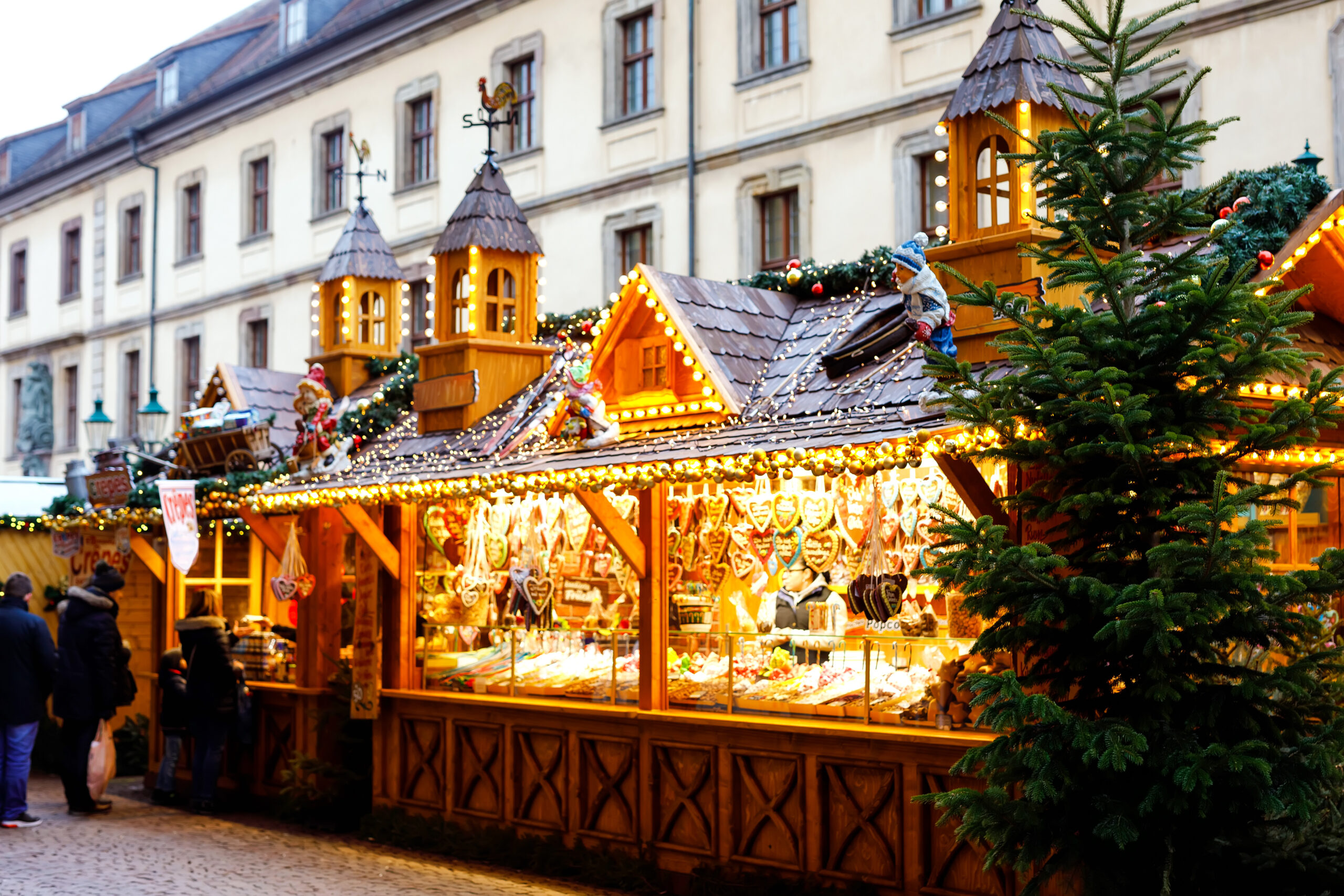
When we think of Christmas markets, Germany often comes to mind – they are the blueprint. The country is teeming with them, and the hardest part is choosing which ones to visit. Cities like Munich, Nuremberg and Cologne certainly go all out for the festive season making them fantastic stops to make.
Cologne hosts some impressive Christmas markets that sprawl across several squares, each with their own theme meaning it’s well worth exploring as many as possible. The most iconic market is set against the backdrop of the Cologne Cathedral where thousands of fairy lights reflect the river Rhine.
In Munich, you’ll want to head to the neo-Gothic town hall as this is where the Marienplatz Christmas market is located. Sip on warm Glühwein as you browse the stalls but make sure someone else is the designated driver!
About 2 hours (~ 170km) south of Munich, you have Nuremberg – home to the renowned Christkindlesmarkt, one of Germany’s oldest markets with roots going as far back as 1530. With it’s red and white striped candy cane stalls and the Christkind delivering her festive prologue from the church balcony, the market is the epitome of tradition. You’ll smell spiced gingerbread (Lebkuchen) and hear sizzling Nuremberg Bratwurst sausages as you browse the stalls selling handcrafted gifts, ornaments and toys.
In 2025, the Nuremberg market runs from the 28th November to the 24th December. Whilst you’re there, don’t miss the opportunity to pick up a classic Nuremberg prune man (Zwetschgenmännle) as a souvenir.
Snowfall is common in southern Germany during December. This of course adds to the charm but it does require cautious driving, especially if you’re heading into Bavaria’s hillier regions.
Austria
Vienna & Salzburg

If you have plans to visit Austria this time of year, you’ll get to experience pure Christmas magic. Start in Vienna; the city exudes Christmas cheer and the grand facades are draped in fairy lights. The most famous market in Vienna is at the Rathausplatz, beautifully framed by the City Hall. With more than 150 stalls to wander, you’ll find everything from ornaments and traditional wooden toys to classic Viennese sweet treats such as Vanillekipferl and Sachertorte.
Once you’ve explored the market stalls, why not have a go at ice skating? The ice rink is set between the neo-baroque Burgtheater and the neo-gothic Vienna City Hall offering perhaps one of the most picturesque skating backdrops in Europe. Vienna’s market is open from the 14th November to the 26th December 2025.
Other famous landmarks like the Schönbrunn Palace (6th November – 6th January) and Belvedere (14th November – 31st December) will also have markets. These are likely to be less busy and also give you an opportunity to visit historic Austria’s historic sites in all their Christmas glory.
About 3.5 hours (~ 300km) from Vienna lies Salzburg – another place you cannot miss if you’re in Austria this time of year. The drive itself is guaranteed to be beautiful, taking you through some gorgeous Austrian alpine snow likely to be dusted in snow.
Salzburg has several Christmas markets, but the most famous is the Christkindlmarkt in Cathedral Square (open 20th November–1st January 2026). Here, choirs sing, a wind orchestra performs carols and traditional folklore like tower blowing bring the festive atmosphere to life, all while the scent of roasted chestnuts and Glühwein drift through the air. Why not also try a traditional Leberkässemmel?
Besides the main market in the Residenzplatz Square, you’ll also find markets at Fortress Hohensalzburg (certainly a market with a view), Mirabellplatz and Hellbrunn Palace. Take a stroll along the Getreidegasse, where boutique shops and glowing Christmas lights make the street feel as though it’s straight out of a storybook. And keep an eye out for Krampus, Santa Klaus’ mischevious counterpart. Thanks to its Alpine location, Salzburg’s baroque architecture may also have a dusting of snow atop to get you feeling extra Christmassy.
Belgium
Ghent & Bruges

Belgium is a fantastic place to visit during the festive season, and Bruges and Ghent should be at the top of your list. In Bruges, often called the ‘Venice of the North’, you’ll be greeted with medieval streets and canals sparkling under festive fairy lights. The main Christmas market in Grote Markt is framed by colourful gabled houses and runs from the 21st November to 4th January 2026. Enjoy a mug of Belgian hot chocolate or mulled wine, and sample Belgian treats like waffles and praline. You could even try ice skating on the rink set in the heart of the square. Bruges also hosts ‘Winter Glow‘, a light trail experience in Koning Albert I-park that’s accompanied by additional Christmas markets and the ‘IJsgloed’ bar.
A short 45-minute drive (~50km) from Bruges brings you to Ghent, an equally vibrant city that blends history with a lively Christmas atmosphere. The market, known as Gentse Winterfeesten, runs from the 4th December to the 31st December. Over 150 stalls stretch from Sint-Baafsplein to Korenmarkt, offering everything from artisanal crafts to spiced speculoos cookies and Belgian beers served in mock chalets. For an extra special view, could climb the Belfry for panoramic views of a city dressed to impress.
If you’re looking to escape busy crowds, take the time to explore smaller Belgian towns like Leuven or Mechelen. Here, you’ll enjoy equally charming markets without all the people.
Czech Republic
Prague
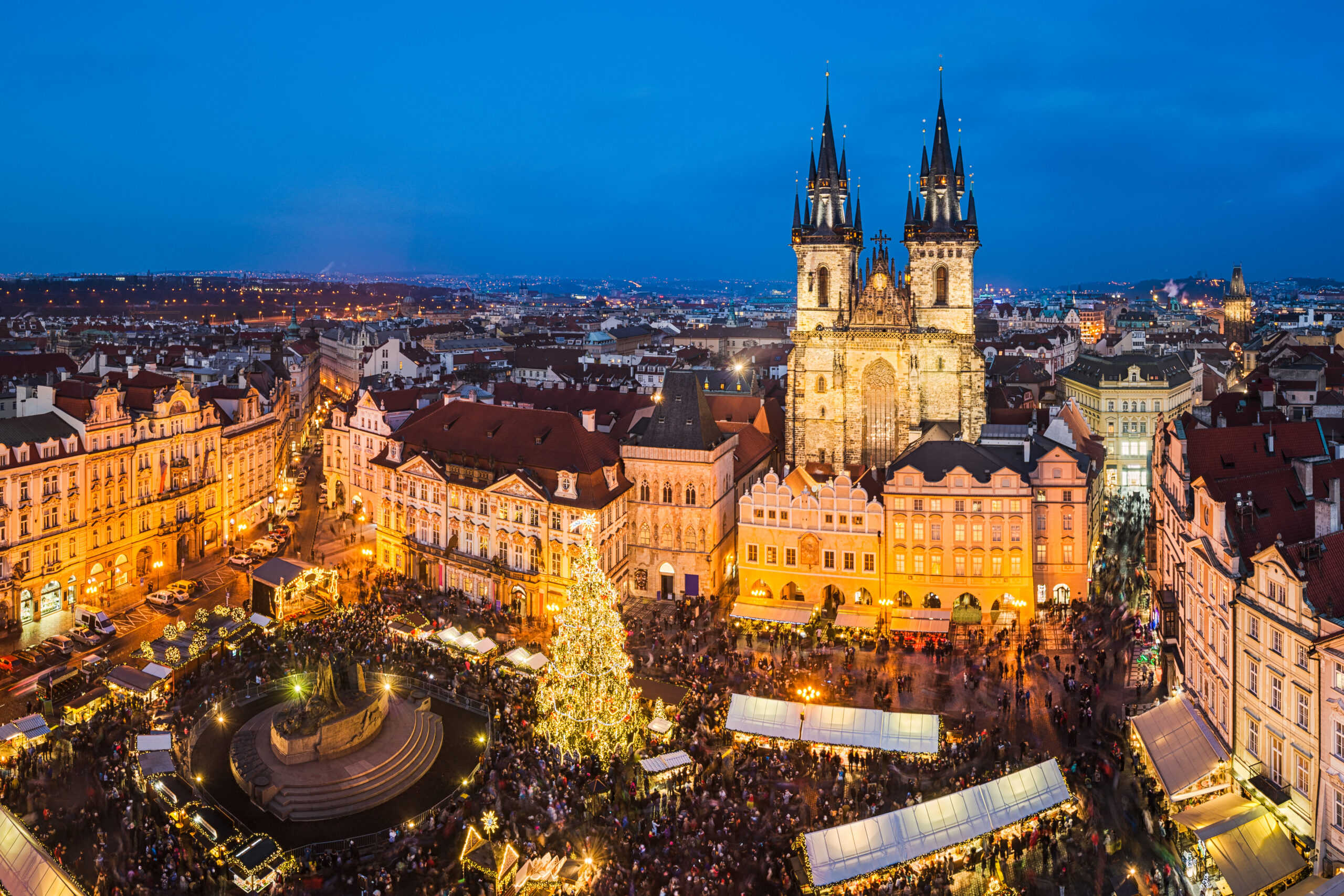
The Christmas markets in Prague are famous for their fairy-tale setting, historic charm and festive atmosphere. The heart of the festive celebrations are located in the Old Town Square where you’ll be met with a tall Christmas tree against the backdrop of the Gothic Church of Our Lady before Týn. In the market themselves, you’ll be able to sample Czech trets such as trdelník, a sweet pastry, and svařák, a local version of mulled wine. The markets run from the 29th November to the 6th January 2026.
Just a short walk away is Wenceslas Square, home to another popular market with plenty of food stalls and festive gifts. For quieter options, head to the Peace Square (Náměstí Míru) or up to Prague Castle where you’ll be able to enjoy smaller markets along with sweeping views of the city Christmas-ified.
Beyond the markets, you can take a walk across Charles Bridge and admire the lights reflecting off the Vltava. And if you happen to be in Prague on the 5th December, you might be able to catch a glimpse of the traditional Czech customs of St Nicholas Day – angels, devils and St. Nicholas parade through the streets.
Prague is also an ideal base for exploring more of the Czech Republic. A 1.5-hour drive (~ 100 km) takes you to Karlovy Vary, famous for its pastel-coloured architecture. Alternatively, head 2 hours (~ 140 km) south to Český Krumlov, one of Europe’s prettiest medieval towns where a castle sits on a perch above the Vltava River.
Poland
Kraków

The heart of Kraków’s Christmas celebrations are in Rynek Główny, the largest medieval square in Europe, where a towering Christmas tree stands beside the historic Cloth Hall (Sukiennice). At the market stalls, you’ll find traditional Polish crafts as well as delicious seasonal treats like pierogi, oscypek (smoked cheese) and mulled wine (grzaniec galicyjski).
If it’s quieter, more atmospheric markets you’re after, head to St Mary’s Basilica and to Kazimierz, Kraków’s historic Jewish quarter. These areas offer a more intimate festive experience with locally made products and less of a commercial feel vibe – ideal if you want something authentic and unique.
For those with a car, consider visiting nearby festive towns like Zakopane, Poland’s winter capital nestled in the Tatra Mountains. The drive takes around 2 hours (~ 110 km) and offers stunning snow-covered mountain views. Zakopane has it’s own markets but is also a fantastic base for skiing and snow walks. Be aware that winter tyres are strongly recommended in Poland due to icy conditions, especially if you’re heading toward the mountains.
Tips for a Stress-Free European Christmas Road Trip
1. Plan your route
If you plan on visiting multiple cities or even multiple countries, make sure to plan out your route factoring in stops for rests and fuel top ups as well as potential winter traffic. Use apps with live traffic and weather updates to avoid your journey taking longer than necessary.
If you’re hiring a car for a multi-country trip, always check with your rental company that cross border travel is allowed. Factor in potential toll roads too.
2. Book hire car early
December can be busy for car rentals across Europe, particularly if you’re heading to a major Christmas market destination. For the best availability and price, book as far in advance as possible. Don’t forget your car hire excess insurance too – this will save you significant money should any accidents or damage occur.
3. Check parking rules
Parking in European cities during the Christmas season can be more difficult than usual as many places will introduce temporary restrictions or become fully pedestrianised. Take time to familiarise yourself with the local parking rules and signage to help you avoid fines or confusion.
To make things easier, consider using park and ride facilities and using shuttle services into the city. This is a quicker and less stressful alternative to attempting to navigate busy city streets.
4. Pack winter car essentials
European winter weather can be unpredictable, so make sure your car is stocked with cold-weather essentials. These include:
- A fully charged mobile phone
- A power bank
- Contact details for your breakdown cover
- Snacks, water and warm clothing
- Blankets
- De-icer and an ice scraper
- A torch and spare batteries
- Sunglasses, as low winter sun can glare off snow and wet roads
It’s also a good idea to check whether your route requires winter tyres or snow chains, as some European regions legally mandate them.
Final Thoughts
Christmas is a magical time to explore Europe, and even if you’ve visited these cities before, the festive season transforms them with lights, markets and a whole new atmosphere. Be sure to make sure your car is winter ready, that you’ve checked the weather forecast before setting off and that you have car hire excess insurance for extra peace of mind. And if you plan to enjoy a warm cup of Glühwein, be sure someone else in your group is the designated driver!

Comments are closed